Red Door Roulette
What happens after the red door opens
A Red Door Roulette feature has an entry condition, a resolution sequence and a settlement. Keep those stages together when comparing bonuses. The practical examples below help distinguish the shared studio event from the outcome credited to an individual wager.
The Red Door bonus is a feature defined by the game, not a welcome package, cashback offer or casino wagering condition. Begin with the bet that qualified to enter it, then follow the feature’s stages until the completed result appears. Promotional conditions belong to a different layer of the account.


Guide sections
Qualifying depends on the bet type
Entry follows a qualifying straight-up stake on the keyed number that wins. A split, colour or other covering selection may pay under its ordinary rules when that number lands, but that payment does not give it the same entitlement to the Red Door feature.
Adding straight-up selections covers extra numbers and, unless the amount on each is reduced, raises the round’s total cost. Describe the stake alongside the coverage. More numbers are not an improvement supplied at no cost simply because they occupy more of the grid.
Keys are assigned after betting
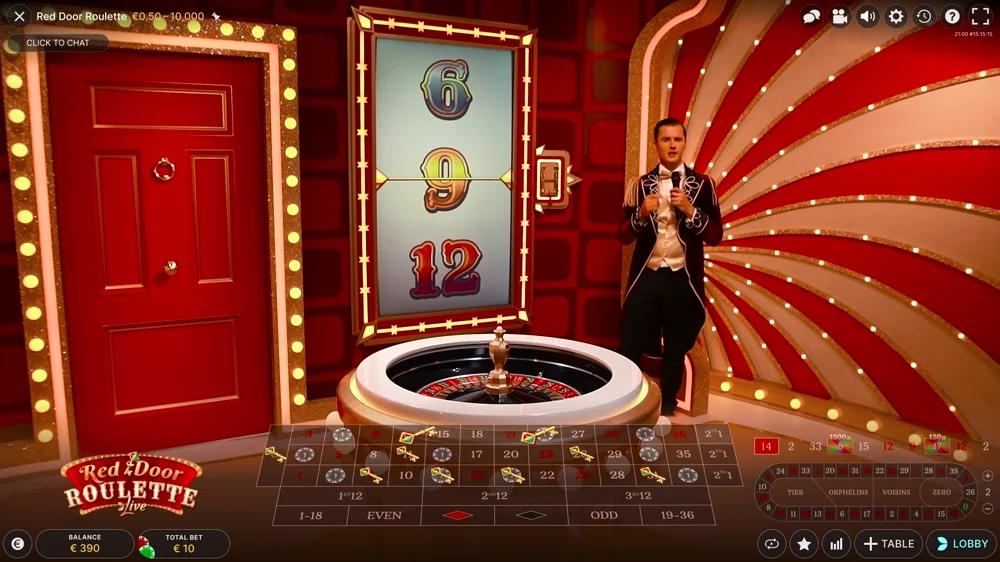
After betting ends, the feature sequence assigns keys to 3–15 distinct numbers. This display is the eligibility map for that round, not an announcement that any backed number has won. It neither guarantees a bonus for every player nor identifies the final roulette pocket before the ball settles.
To establish qualification, match three items: the winning pocket, that round’s key display and the straight-up number on your accepted layout. Each supplies a different part of the evidence needed.



How the extra modifier enters the feature
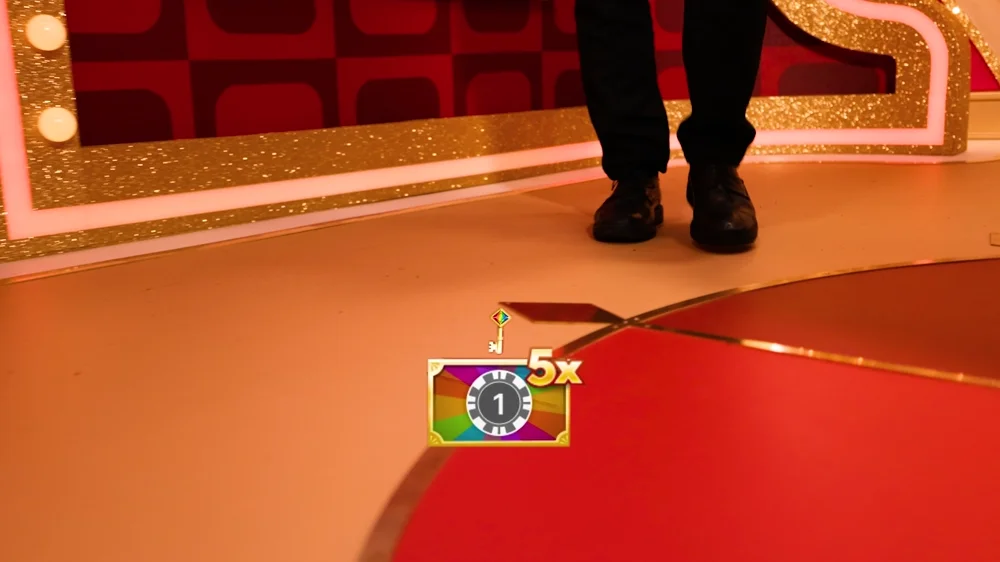
A 2x–20x modifier may be assigned before the feature spins, scaling the bonus wheel’s values. Treat that as an intermediate stage. If the final published factor already contains the modifier, applying it again would count the same effect twice rather than explain the completed result.
For multiplication practice only, a wheel value of 5x scaled by a 2x modifier becomes 10x. This abstract example shows the operation. It does not tell you how a particular public-feed field accounts for the original stake or intermediate feature values.
The wheel can continue on DOUBLE
The feature resolves on a 64-segment multiplier wheel. When DOUBLE occurs, the values double and the wheel spins again. A bonus can therefore involve several wheel actions before a final value is reached; the first action is not necessarily the end of the round.
A short highlight can leave out the stage that determines the ultimate result. A multiplier visible partway through the bonus may change before settlement and should not automatically be treated as the completed figure in the round history.
What the 4,000x ceiling means
Evolution’s published Red Door Roulette description gives a maximum multiplier of 4,000x. This defines a ceiling under the game rules. It is not an indication of a usual payment, nor does the figure by itself state the likelihood of reaching that ceiling.
Check the active table for cash win caps, permitted stakes and market-specific conditions. A monetary limit quoted for another operator is not automatically transferable. Nor should the headline maximum be multiplied by the whole multi-bet layout without identifying which individual selection actually qualified for the feature.
Keep casino promotions in a separate calculation
For any account credit or cashback promotion, inspect the expiry, eligibility, permitted stake, live-game contribution and withdrawal terms. A bonus within the game is not evidence that the game contributes fully to a casino offer’s turnover requirement. The two uses of “bonus” refer to separate sets of rules.
As a hypothetical promotion calculation, 20 units of bonus credit multiplied by a 30x turnover requirement gives 600 units before applying any game-contribution rule. This example is only arithmetic. It does not advertise an offer from this site or establish the terms currently provided by an operator.

A keyed number is a condition, not a separate purchase
The route into the feature belongs to the eligible straight-up bet. A broad “all numbers” layout, an outside bet or a promotional balance does not automatically purchase every possible bonus. Determine the accepted layout first, then compare it with the winning pocket and the key assigned to that number.
Cost remains visible before the reveal
Eight separate numbers at 1 unit each create an 8-unit round before the keys are revealed. Four numbers at that same denomination halve the cost and reduce coverage. Neither choice makes any backed pocket certain to land. Compare the exposure and total spending before drawing impressions from an especially attractive recorded bonus.
Follow the indicator and the final feature state
A flapper indicates the result on the multiplier wheel. If the interface offers a choice, use its actual controls and countdown to understand that choice. A recording may show only one indicator or viewpoint and consequently may not document the outcome path followed by every participant.
Track the pre-bonus modifier, any DOUBLE continuation and the completed value in their time order. Avoid applying an intermediate factor again to a final combined number. If the source does not document its calculation convention, label the supplied figure as a source multiplier rather than inventing a player’s cash return from it.
Read maximum multiplier and maximum money separately
A cash win cap and a multiplier ceiling can both constrain an outcome. A regional rules sheet may quote a cap in the local currency; that is not automatically a worldwide limit. Similarly, the maximum allowed stake is not necessarily an amount permitted on each individual position in a combined layout.
Read the current table rules for your specific bet and account currency before interpreting a return. Examples of unusually large features illustrate the order of events, but selected examples are not a sample from which to infer frequency. For a defined sample, use the history panel; for the distinction between total turnover and net result, consult the strategy guide.
Separate the two multiplication stages
The initial modifier and a later DOUBLE are separate operations. To illustrate their order, start with a wheel value of 5: a 2x modifier makes it 10, and one further doubling makes it 20. These numbers demonstrate calculation only, not an actual spin result or a settled monetary payment to a player.
A finished source record can already include some or all of the feature stages. Applying extra multiplication without a documented field definition risks counting an effect twice. Keep the intermediate stages in worked explanations, and display the supplied completed figure as such in the history.
Read a feature highlight as one selected event
A clip containing a large result proves what appears in that clip, not how many ordinary or losing rounds occurred around it. Discussing frequency requires a defined period and a count of the entire available sample. Any holes in that period’s coverage should remain explicit in the comparison.
A prolonged DOUBLE chain also lasts longer than a simple roulette settlement. Comparing bonus counts per minute in selected highlights can therefore give a distorted impression. Elapsed time and events per sampled round are different measures; use the denominator appropriate to the question instead of mixing them.
THE PRACTICAL DESK
Put the numbers to work
Change the example inputs to see how the arithmetic changes. These tools use the figures you enter; they do not read your casino account or predict a game result.
Round balance
Follow the mechanic into another game
Gold Vault Roulette and MONOPOLY Roulette also build special features around a single-zero wheel. Their enhancement and qualification rules differ, so transfer neither the payout nor the eligibility rule from one table to another.


Questions and answers
Is the Red Door bonus a deposit bonus?
No. It is a game feature. Account promotions have separate terms.
Can an outside bet enter the bonus?
An outside bet covering the winning number is insufficient by itself. The feature requires the qualifying straight-up selection, rather than ordinary outside-bet coverage alone.
Is 4,000x the usual result?
No. It is the published maximum, not an average or expected outcome.
EVOLUTION GAMES GUIDE