Evolution · Rules and results
Red Door Roulette: from winning number to bonus wheel
How does Red Door Roulette turn a wager into a completed round? Start with its event sequence, then compare the feature rules, the recorded history and the account conditions. The sections below connect those three parts without treating a promotional image as a complete rulebook.
A single-zero roulette table supplies the base game in Red Door Roulette, while a separate wheel supplies its multiplier bonus. To interpret a round, you need to connect three things: the number that wins, the keys displayed on the betting grid and the entry subsequently published in the history feed. Read the rules first; the dashboard then lets you examine precisely what the source recorded.
0–36single-zero wheel
3–15keys per round
19:1ordinary straight-up
Evolutiongame provider
Loading records…
The records come from LiveCasinoData and are supplied under CC BY 4.0. This is a third-party dataset rather than an official Evolution feed. We reproduce the categories and factors supplied by that source, which may contain delays or gaps. A multiplier recorded for a round does not, on its own, establish any individual player’s payout.
Guide sections
Evolution · Red Door Roulette
Recorded preview
The preview is recorded; it is not a live broadcast or a playable casino table.
Ordinary bet payouts
| Bet | Numbers covered | Profit payout |
|---|---|---|
| Straight-up | 1 | 19:1 |
| Split | 2 | 17:1 |
| Street | 3 | 11:1 |
| Corner | 4 | 8:1 |
| Six line | 6 | 5:1 |
| Dozen | 12 | 2:1 |
| Column | 12 | 2:1 |
| Red / black | 18 | 1:1 |
| Odd / even | 18 | 1:1 |
| Low / high | 18 | 1:1 |
The table lists ordinary payments before any qualifying feature is applied. Bonus entry remains limited to the eligible straight-up bet on the winning keyed number.
A roulette result with a second possible stage
Begin with the roulette result: the winning pocket is one of the numbers from 0 to 36. Before an applicable feature is added, a standard straight-up win pays 19:1. Using the usual 35:1 roulette calculation would therefore produce an incorrect return. Entry to the feature requires both an eligible winning number and your own straight-up bet on that number.
A covering wager keeps its own identity: red or black, odd or even and the other group selections are separate bet types. Holding a larger group that happens to contain the winning number does not itself purchase admission to the Red Door bonus. When a result carries a bonus label, first check which type of bet you actually selected.
From closed betting to the bonus wheel
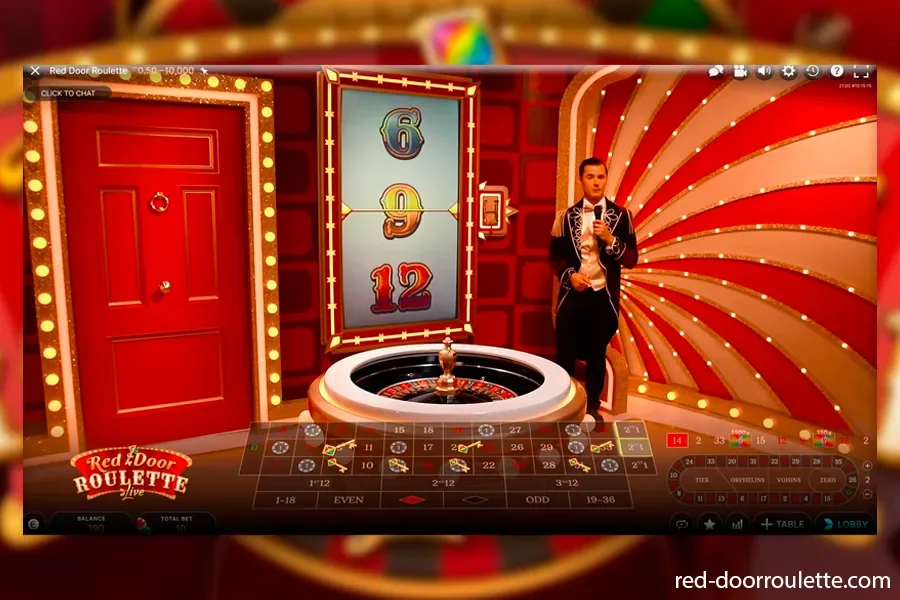
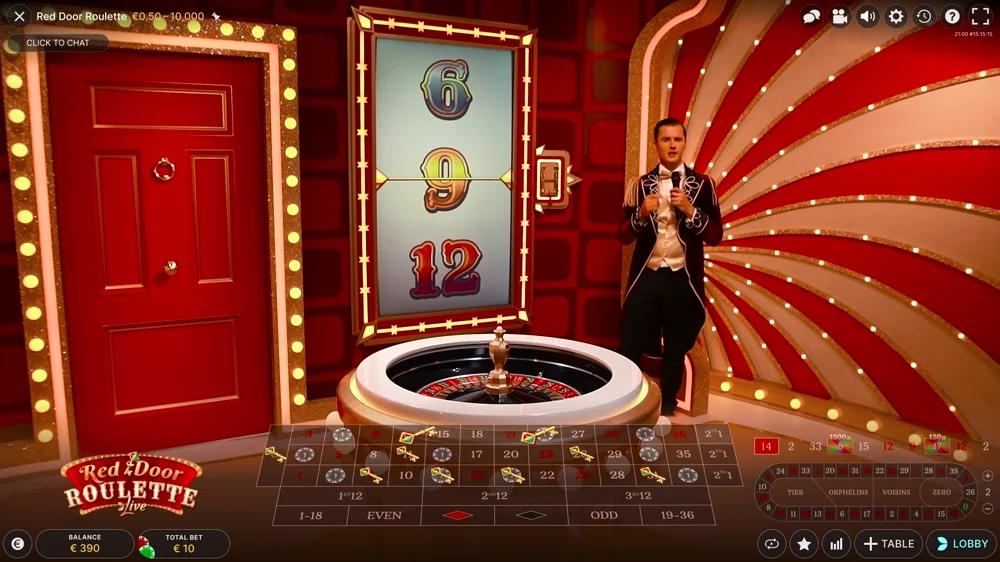
The automated roulette wheel starts after bets close, while the presenter activates the slot-style key reveal. Between 3–15 distinct numbers receive a key, with no number receiving more than one in that round. Read that display as the current round’s eligibility map, not as a lasting advantage attached to particular pockets.
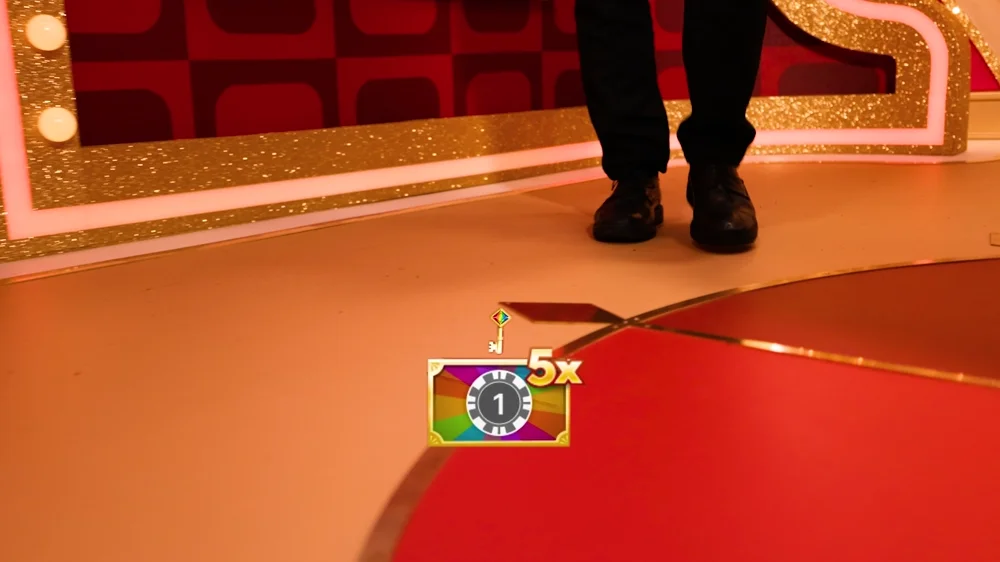
A modifier from 2x–20x may be added before the bonus. When the eligible winning number qualifies, that factor scales the values on the 64-segment wheel behind the door. A DOUBLE increases those values and requires another spin. The published 4,000x maximum is the feature’s ceiling, rather than an amount to expect from an ordinary result.


Read recent results with their timestamps
The dashboard arranges events delivered by the outside data supplier. Narrow them with the period and outcome filters, then inspect the newest source timestamp to judge freshness. A completed refresh establishes that a request succeeded; it does not establish that another roulette round has since occurred or been published.
Every percentage needs the number of returned records beside it. Five occurrences among 100 rows mean 5%; five among 1,000 mean 0.5%. A delayed, cached or incomplete selection of rows is not automatically a whole day. Older data remains useful for historical analysis when its age and coverage are made explicit.
Which record are you looking at?
Read the three kinds of evidence separately. The roulette number identifies a pocket, a supplied multiplier describes a field in the game record, and an account transaction describes settlement of your accepted wagers. The latter includes your positions, stake amounts, applicable rules and any cap that the public row does not contain.
A row labelled 15 does not show whether a viewer staked on 15, a split covering it, black, or nothing. Without those selections and stake sizes, its associated multiplier cannot be translated into that viewer’s profit. This missing context is particularly important for a round containing several different chips.
What roulette probability can and cannot tell you
Under the equal-pocket model, one number has 1 chance in 37 on a single-zero wheel, approximately 2.70%. Red and black cover 18 numbers apiece, with zero outside both colour selections. These figures describe the layout’s coverage, not a prediction derived from the preceding sequence of spins.
The keys add an eligibility layer to the number result. Several keyed pockets do not mean your backed pocket has already won, and an extended absence does not make it due. Hot/cold rankings count occurrences in the selected records; their ordering is not an instruction to raise a stake.
Keep stake, return and net result separate
For a basic 19:1 straight-up win, a hypothetical 1-unit chip earns 19 profit and returns its original 1 unit. If the layout contained five different 1-unit number bets and exactly one won without a feature, the gross return would be 20 against a total stake of 5, leaving 15 units net.
This example covers ordinary payout arithmetic, not a feature payment or a particular player account. Apply the winning rate to the eligible chip, never to all money spent on the round. The four other chips are separate losing bets. Use the same selection-by-selection discipline when mixing inside and outside positions.

Learn the interface before choosing a stake
Find the table help, active limits, total stake, clear or undo controls and personal-history panel before beginning. Repeat may bring back a whole layout of chips at once. After using it, inspect the complete grid and combined total instead of looking only at the last number selected.
The demo section distinguishes three different tools: a saved video, a read-only history panel and a genuine table using virtual credit. They serve different purposes. This independent site provides information and neither receives wagers nor maintains a player’s gambling balance.
Mobile access is an operator question
Evolution supplies the title, but the account host controls sign-in, identity checks, currency and cashier methods. A page advertising a Red Door Roulette download does not prove that the application is official. Establish the access route from the operator’s verified website or the store listing linked by that operator.
On mobile, check that the complete betting layout is usable and the total remains visible. Should the video stop, consult account history before sending a selection again. A delay in the picture is not evidence that the server rejected the instruction already submitted.
Use strategy tools as descriptions, not predictions
A progression changes the money exposed after each result; it does not change the pocket selected by the wheel. Compare plans using identical starting balances, samples, targets and stopping conditions. Broader number coverage also raises the round cost unless the amount allocated to each chip is reduced.
Public data cannot reconstruct every participant’s bonus choices and precise settlement. A hypothetical replay must name its assumptions instead of calling the supplied factor a verified personal return. Keep a fixed budget and predetermined stopping point rather than using an absent number as a reason to chase another round.
A practical route through this guide
Use How to play for the full order of a round. Turn to Symbols for an unclear key, modifier or DOUBLE label. The bonus guide separates the qualifying stake from the multiplier-wheel sequence that follows, while Results explains which sample is shown and how its timestamps should be read.
Before opening an operator account, verify eligibility, the exact rules and account limits. Recorded results can provide context but cannot promise the following outcome. Take breaks, and keep money needed for ordinary living expenses separate from any amount allocated to gambling.
The payout table explains the trade-off
The ordinary straight-up payment is the main arithmetic difference from conventional single-zero roulette: it is 19:1 here. The published rules retain the familiar coverage-based payments for the other standard bet categories. The extra feature belongs to the straight-up route, not to a universal side bet automatically added to all winning selections.
Compare the selection, not only the number
Both a split and a straight-up chip can include the winning pocket, but they keep different payment rates and feature eligibility. The table uses profit-to-stake notation: a 1-unit split paying 17:1 produces 17 profit plus the original unit, not merely 17 total. Other losing chips must still be removed when calculating the combined round result.
RTP is different from hit frequency
The published theoretical RTP is 97.09% for straight-up positions and 97.30% for other standard selections. Their corresponding house margins are 2.91% and 2.70%. These long-run mathematical values are neither the share of rounds that win nor a commitment about how long a particular player’s deposit will last.
Turnover is the useful denominator
Consider an illustrative cumulative straight-up turnover of 10,000 units. Applying a theoretical margin of 2.91% gives 291 units in the long-run expectation model, rather than a predicted loss for one particular account. Short runs can deviate substantially from that model, and a monetary win cap may change effective return. Consult the rules for the edition you actually open instead of importing a cash limit from another region. The bonus explanation also explains how occasional very large multipliers can occur alongside many losing selections.
One layout can contain several separate outcomes
Consider a no-feature example with 2 units on each of three numbers, costing 6 in total. If one number has an ordinary 19:1 win, that chip credits 40 and the other two credit zero, for a net result of 34. If all three miss, the result is minus 6. The example calculates a stated layout rather than converting an unexplained historical factor into account money.
Mixing inside and outside bets
Now place 1 unit on a particular red number and 2 units on red, spending 3 altogether. An ordinary straight-up win on that number credits 20 from the number and 4 from red: 24 gross and 21 net. A different red pocket credits only 4, leaving 1 net; black loses both bets. Writing the layout first makes the different outcomes clear.
Red Door, Lightning Roulette and Crazy Time are distinct games
The show combines multiplier-roulette ideas with a bonus resembling Crazy Time’s wheel, but those products are not interchangeable. Red Door Roulette starts with a roulette pocket, while Crazy Time starts with its own game-show wheel. Footage of the other title cannot therefore serve as a round in this game’s result history.
Rules and limits described in a Lightning Roulette guide may belong to a different feature altogether. Confirm the full title both in the lobby and in the table’s rules panel; a lightning graphic or red curtain is insufficient identification. Use the symbol guide to connect the visuals to their respective stages, and the playing guide to follow the proper order of placing and settling a wager.
The Spanish edition and market-specific settings
The global introduction of Red Door Roulette came in November 2023. Evolution announced the Spanish version, Ruleta Puerta Roja en Vivo, in November 2025, streaming from Murcia with Spanish-speaking presenters. That translated title identifies the edition; it does not prove that every casino carrying it can accept every visitor.
Verify table availability, account region and language independently. The service in use may determine the currency, permitted stakes and cash win cap, so those account-specific details should not become universal game specifications. Reading a Spanish guide changes the explanation’s language, not a reader’s eligibility or the casino account’s terms.
The useful features and the limits to weigh up
What makes the format easy to recognise
The settled number gives a clear opening reference, the keys identify the current round’s feature-eligible pockets, and the red door marks the transition to a separate multiplier wheel. Once those layers are distinguished, the complete sequence is easier to follow without mistaking every new animation for another wager.
What deserves extra attention
Familiar roulette calculations need adjustment because the ordinary straight-up payout is lower here. A layout covered in chips can disguise its total cost, while a headline multiplier says little about every participant’s net return. Feature rounds can also take different lengths of time. Observe outcomes through the recorded history, and check settlement through your actual account history. Keeping those purposes separate makes the information useful without treating it as a prediction service or a decision on a disputed bet.
Why zero changes the statistics
A single-zero layout contains 18 red pockets, 18 black pockets and the separate zero. In the equal-pocket model, each colour has 18/37 ≈ 48.65% coverage, and zero has 1/37 ≈ 2.70%. Odd/even and high/low selections likewise exclude zero from their ordinary outside-bet coverage.
Removing zero and counting only red and black changes the denominator, distorting a comparison with the complete wheel. Keyed feature qualification is another condition on an eligible straight-up wager. An ordinary colour win alone does not take a player into the Red Door bonus.
THE PRACTICAL DESK
Put the numbers to work
Change the example inputs to see how the arithmetic changes. These tools use the figures you enter; they do not read your casino account or predict a game result.
Round balance
Spending plan
Follow the mechanic into another game
Gold Vault Roulette and MONOPOLY Roulette also build special features around a single-zero wheel. Their enhancement and qualification rules differ, so transfer neither the payout nor the eligibility rule from one table to another.



EVOLUTION / NEWSROOM
From the provider’s newsroom
A real capture of Evolution’s announcement. The announcement describes this release and its market; it does not establish access for every account.
Read the original announcement ↗Know the game? Try the table
Open the available play options and review the table limits before you start.
Play Now 18+ · Eligibility and operator terms apply.
Questions and answers
Is Red Door Roulette ordinary European roulette?
The numbers follow the single-zero 0–36 layout, but the feature rules and ordinary straight-up payment differ from conventional roulette. That ordinary payment is 19:1 here rather than 35:1.
Does a red or black win open the door?
No. The winning keyed number must have been backed with the qualifying straight-up bet. A colour selection by itself does not meet the conditions for feature entry.
Does the results multiplier equal my profit?
No. The feed lacks the complete set of bets accepted on your account and the transaction that settled them. It cannot establish your individual return.
Is a long-missing number more likely next?
A historical absence does not make a pocket due on the next round.
Are the results live without delay?
The display receives a round after the outside source publishes it. Read the source timestamp and connection status to judge freshness instead of assuming the records arrive without delay.
EVOLUTION GAMES GUIDE